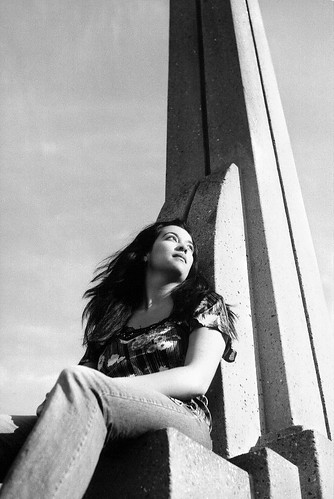
This was me in Vancouver waaay back in 2006. I was in town for the World Urban Forum III and met up with a flickr friend for a little portrait session. So much has changed since then. One thing has stayed constant though. I continue to make friends through photography.
This weekend I'm headed to Vancouver again, this time for my cousin Marc's wedding (where I am the official photographer). Acting as my assistants are two of my bestest boy friends, both of whom are brilliant photographers themselves. The weekend will be full of photographic delights. I cannot wait to go. I am positively giddy with excitement.
I am so ready for this trip.
As promised, here's my extended rant about Schwarzenegger and the textbook ban. I'm surprised I haven't heard more about this in the news. I first came across the story nearly a month ago and it's been sitting in the blog queue since then. Good thing I read lots of heavy books because now I can flex some pretty impressive writing muscles.
I decided that this topic warranted a bit more reading (I wanted some scholarly advice), so after a trip to Google Scholar I came upon this article from by Wendy Sutherland-Smith, Weaving the literacy Web, Changes in Reading from page to screen (The Reading Teacher, Newark: Apr 2002. Vol. 55, Iss. 7; pg. 662, 8 pgs). The abstract drew me in, Sutherland-Smith explores the unique reading strategies needed for the World Wide Web. She considers additions needed in the repertoire of teaching reading strategies when computers are the medium. Although written in 2002, the strategies she proposes are still relevant and probably still not as widely known as they should be. While I will quote extensively from the article, I do suggest that you click through and read it.
This textbook ban has more far-reaching implications that just being a cost-saving measure. It will have a significant impact on literacy (both positive and negative). According to the UNESCO position paper on The Plurality of Literacy and its implications for Policies and Programs 'literacy' is the ability to identify, understand, interpret, create, communicate, compute and use printed and written materials associated with varying contexts. Literacy involves a continuum of learning to enable an individual to achieve his or her goals, to develop his or her knowledge and potential, and to participate fully in the wider society. It's a no brainer that literacy is important. But as Sutherland-Smith states, "Clearly, literacy is not a static concept. Leu (1997) saw it as a "deictic" term, because "it's meaning is continually changing, dependent upon the technological context in which it occurs" (p.62). So what is meant when we talk about web literacy? Sutherland-Smith explains,
More from Sutherland-Smith,

Mr. Schwarzenegger announced the ban on textbooks in a classroom in Sacramento, holding up four large text books and joking: "I can use these for the (bicep) curls."There's just something so wrong about that statement. Why Arnie? Why?
"Textbooks are outdated, in my my opinion," he said. "For so many years, we've been trying to teach exactly the same way. Our kids gets their information from the internet, downloaded onto their iPods, and in Twitter feeds to their cellphones... Basically kids are feeling as comfortable with their electronic devices as I was with my pencils and crayons. So why are California's school students still forced to lug around antiquated, heavy, expensive textbooks? (via Telegraph.co.uk)Isn't anyone else concerned by this? Or at least the tiniest bit curious about the implications of banning textbooks in the classroom? Maybe it's just the wannabe academic in me, but this topic both depresses and intrigues me. I'm fascinated by the cognitive changes that have come about due to shifts in technology, particularly when it comes to reading. Compare reading a newspaper to an article online. The differences are not so subtle. Our eyes move across the text in new patterns, our level of concentration varies, our mind wanders. Reading text on a physical page versus reading text on a screen is very different. One does not simply replace the other. Like Neil Postman said, "technology giveth and technology taketh away." I wonder how much thought the Californians have given to this.
I decided that this topic warranted a bit more reading (I wanted some scholarly advice), so after a trip to Google Scholar I came upon this article from by Wendy Sutherland-Smith, Weaving the literacy Web, Changes in Reading from page to screen (The Reading Teacher, Newark: Apr 2002. Vol. 55, Iss. 7; pg. 662, 8 pgs). The abstract drew me in, Sutherland-Smith explores the unique reading strategies needed for the World Wide Web. She considers additions needed in the repertoire of teaching reading strategies when computers are the medium. Although written in 2002, the strategies she proposes are still relevant and probably still not as widely known as they should be. While I will quote extensively from the article, I do suggest that you click through and read it.
This textbook ban has more far-reaching implications that just being a cost-saving measure. It will have a significant impact on literacy (both positive and negative). According to the UNESCO position paper on The Plurality of Literacy and its implications for Policies and Programs 'literacy' is the ability to identify, understand, interpret, create, communicate, compute and use printed and written materials associated with varying contexts. Literacy involves a continuum of learning to enable an individual to achieve his or her goals, to develop his or her knowledge and potential, and to participate fully in the wider society. It's a no brainer that literacy is important. But as Sutherland-Smith states, "Clearly, literacy is not a static concept. Leu (1997) saw it as a "deictic" term, because "it's meaning is continually changing, dependent upon the technological context in which it occurs" (p.62). So what is meant when we talk about web literacy? Sutherland-Smith explains,
Web Literacy is a term for finding, scanning, digesting, and storing Internet information. It is "an ability to recognize and assess a wide range of rhetorical situations and an attentiveness to the information conveyed in the source's non-textual features" (Corapure et al. 1998, p.410). This understanding is significant, as it represents a "fundamental change" (Leu, 2000, p. 424) in thinking about being literate in the 21st Century. The speed and degree of change that Web literacy brings to teaching reading is an implementation challenge for us teachers. As Sorapure et al. pointed out, the web is a "vast, open , and uncategorized library, and one in which reference librarians are nowhere to be found" (p.410). The Internet can be an intimidating and difficult medium to manage, with its constant rapid changes, but technology skills are essential for survival in the 21st century. Therefore students and teachers must be competent and more important, comfortable with the medium... Web literacy demands an incorporation of key reading or navigation skills. These include accessing information, analysing information (including multimedia), and processing procedures to store or move text. While these skills appear to be the same as those used with print text, academic writers tend to agree that Web literacy involves expanding critical reading skills to incorporate evaluation of visual and nontextual features and a greater use of associative logic (see Bolter, 1991; Burbules, 1997; Charney, 1994; Leu, 1996; Reinking, 1998; Shetzer and Warschauer, 2000; Snyder, 1999).I do think Arnie was right about one thing (or at least I agree with the sentiment he was trying to convey), the way we access the majority of our information has changed and continues to change. Although where he gets this idea that kids are the ones on Twitter I'm not quite sure... and maybe the iPod Touch is more ubiquitious in California, but I don't think that kids are accessing the majority of the information they access online through their mp3 payers, nor do I think its a reasonable comparison to parallel pencils and crayons to electronic devices. Nevertheless, I do think it's important that we adjust to those shifts in information access. But we need to keep in mind that technology is not neutral, and we shouldn't just cast aside the old ways of doing things in favour of some glossy new 'improvement'. Surely that's common sense. However, as Sutherland-Smith continues, when it comes to technology in education some advocate an even more extreme approach.
Having written about Postman before, it's not secret that I am a fan of his views about how technology is affecting society. However, I'd like to put it forward that I am not against the integration of technology in the classroom. Quite the contrary really, I'm a big proponent of it. However, it needs to be done properly. I've worked in a setting where new and exciting technology had been introduced to students without the majority of the teachers having any understanding of how to properly use the tools or integrate them into the curriculum. It was maddening to see how both the students and teachers were struggling to use the tools effectively. Although there were a select few who managed to use the tool to their advantage, for the majority, due to the lack of appropriate instruction (for both teachers and students), the technology proved to be more of a hindrance to any real progress (albeit a flashy and exciting one). I don't think the teachers were to blame for this (many didn't have any choice about whether or not the technology would be used in the classroom, they were told it had to integrated but then not given appropriate direction how to do so). It was more a fundamental problem with the way this particular program was rolled out. It was almost as if the technology came first and then a problem was sought out for that technology to solve. But that's a backwards approach.Many writers oppose using technology in classrooms and advocate a critical approach to the issue of technology. Birkets (1994) and Postman (1995) believed that the advent of computer technology will lead to an impoverishment of the English language. They contended that poor concentration skills in dealing with lengthy and deep textual reading, poor writing skills, and a superficial understanding of issues, due to the lack of depth in reading, will result from Technology in English teaching classrooms. Stoll (1995, p.26) added that he "rarely finds prose that's articulate and create" from the "mediocre writing and poorly thought-out arguments" of Internet-based writing. Leu (1996), whilst supporting the advent of digital literacy, advocated that we keep the concerns of Birkerts (1994) and Stoll (1995) in mind, or "we may become familiar with much but understand little" (p.163).
More from Sutherland-Smith,
I think what bothers me most about this textbook ban is the seeming lack of critical perspective. When the "problem" that is being solved with the ban of textbooks/introduction of tecnology in the classroom is the state of the Californian economy, it is difficult for me to believe that the state of education is really being taken into consideration. As if technology will somehow save California from bankruptcy. Doesn't it seem that any money that is saved will be at the expense of the students? What's the point of introducting a new technology in a classroom if the teachers and students aren't given the appropriate support? It's not as simple of replacing a book with an electronic version. Where is the money for improved infrastructure, will there be enough computers for all of the students? What about the digital divide - not everyone has a personal computer. What about the implications of reading from the internet? Do all teachers have the knowledge/training/understanding to provide students with appropriate strategies for how to read and learn from online material? It's not an even swap. Switching mediums opens up a whole new world of possibilities and challenges. It's sort of like stuffing a square peg into a round hole. In the words of the philosopher Derek Zoolander, "How can we be expected to teach children to learn how to read if they can't even fit inside the building?"As a teacher operating in both print-based and technology mediated classrooms, I
consider it crucial to institute that critical evaluation of the manner in which technology is used in the classroom. This means not only evaluating reading and writing products or technology programs, but also investigating whether technology is being used simply because it is technology (see also Lankshear, Snyder & Green, 2000). It is, however, implausible that the impact that the Internet is having on society and education can be ignored. In fact, "the Web has already entered our classrooms as we debate its value and its effects." (Sorapure et al. 1998, p.412), and we, as teachers, must weave the expanding web of technology into our classroom
practice....a critical perspective must be maintained as to the purposes and appropriateness of technology in our classrooms, as teachers we are required to assist our students with new Web text reading strategies. In addition, we need to become "technology critics as well as technology users" (Selfe & Selfe, 1994, p.484) in order to effectively implement education policy for our students.
This post has been simmering on the backburner for nearly a month. It's about time I gave it some attention. The problem is, I'm not really in the mood to finish it. But I will make my best attempt.
Certain things alarm me. One such thing is ignorance, another is bone-headed attempts to save money at the risk of significant cultural and cognitive change (so I guess there is really only one thing). This rant is inspired by my being alarmed... alarmed by the news of the Terminator's plan to phase out school text books in favour of internet aids and by the passing of Bill 44 (a topic I've avoided discussing until now because it depresses me so). All this on the heels on my attempts to write a more positively flavoured post about some of the more encouraging stories I've read lately (The Equity Project, A New Liberal Arts). But since I have to start somewhere I'll start with the good news (and perhaps even just end there too).
Somewhere, buried under a series of useless status updates and vanity posts on facebook and twitter, there exists a link to TED lecture given by Bennington College President Elizabeth Coleman about reforming higher education, moving away from increasingly narrow areas of study to a truly cross-disciplinary education, one that dynamically combines all areas of study to address the great problems of our day. Is this just a lofty goal or much needed radical rethinking of education?
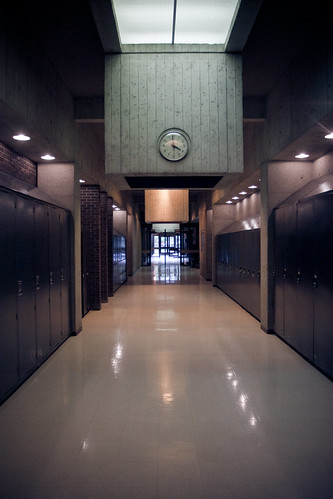
It seems forever ago that I watched this particular video, but at the time I was mindful enough to write down some of Liz Coleman's comments that I found most thought provoking, particularly what she had to say about civic consciousness. Perhaps it has been my recent immersion in the world of municipal politics, but I've been thinking recently about what makes a good citizen and the role that education plays in shaping that good citizen.
I had more planned for this post, but it's getting late and I think the topic of Schwarzenegger and the textbook ban is deserving of its own rant. I have more to say about the plan for a new liberal arts too, but this topic is almost a bit too intellectual for me to process at the moment. I have other things on my mind. But as always, the benefit of this blog is that I can stop and start writing about things as I please.
Certain things alarm me. One such thing is ignorance, another is bone-headed attempts to save money at the risk of significant cultural and cognitive change (so I guess there is really only one thing). This rant is inspired by my being alarmed... alarmed by the news of the Terminator's plan to phase out school text books in favour of internet aids and by the passing of Bill 44 (a topic I've avoided discussing until now because it depresses me so). All this on the heels on my attempts to write a more positively flavoured post about some of the more encouraging stories I've read lately (The Equity Project, A New Liberal Arts). But since I have to start somewhere I'll start with the good news (and perhaps even just end there too).
Somewhere, buried under a series of useless status updates and vanity posts on facebook and twitter, there exists a link to TED lecture given by Bennington College President Elizabeth Coleman about reforming higher education, moving away from increasingly narrow areas of study to a truly cross-disciplinary education, one that dynamically combines all areas of study to address the great problems of our day. Is this just a lofty goal or much needed radical rethinking of education?
It seems forever ago that I watched this particular video, but at the time I was mindful enough to write down some of Liz Coleman's comments that I found most thought provoking, particularly what she had to say about civic consciousness. Perhaps it has been my recent immersion in the world of municipal politics, but I've been thinking recently about what makes a good citizen and the role that education plays in shaping that good citizen.
Civic consciousness and behavior are formed at the intersection of study and engagement - reflection and action - and in public settings where difference and conflict are plentiful and treated as assets, instead of liabilities.Although Coleman later related these comments to a post-secondary context, I don't see the harm in looking at them in the more general terms, for example the public school system. After all, what should public school be other than the ultimate form of general studies preparing us for life. I don't think it's far fetched to wish that education be used as a way to develop good citizens. And I don't just mean devoting a small portion of the social studies curriculum to civics. Being a good citizen is more than just understanding how decisions are made - it's also about being able to deal with conflict and difference and still being able to make society function. And dealing with these issues does not include segregating ourselves or escaping into a cocoon of ignorance. But isn't that exactly what Bill 44 allows? What is wrong with a little bit of controversy? And who determines what is controversial? Why do we have no trust in our educators?
I had more planned for this post, but it's getting late and I think the topic of Schwarzenegger and the textbook ban is deserving of its own rant. I have more to say about the plan for a new liberal arts too, but this topic is almost a bit too intellectual for me to process at the moment. I have other things on my mind. But as always, the benefit of this blog is that I can stop and start writing about things as I please.
I've had a lot of opportunity to take photos for work recently, including photographing the ICLEI World Congress. I was so happy for this opportunity and I absolutely adored every minute of it even though it proved to be extremely exhausting. I think my body is still catching up. But it felt so good to be behind the camera. I kept on telling people all week that being the event photographer was the best thing ever because it gave me an all access pass to go wherever I wanted to go and no one complained or hid when I was trying to take their photo.
Event photography can be a little dull sometimes if you are restricted to only shooting the presenters. Thankfully, we (there were four photographers total) were given carte blanche to photograph as we pleased. So, after completing my shot list (which was really to make sure that the speakers were photographed) I started to look for a theme. Soon what I was looking for found me. The Congress program (or programme if you prefer) was jam-packed which meant that sessions were long. Add in serious content, dim lights and delegates jet lag and you could often find people in various poses of serious contemplation or near exhaustion, with their head in their hands, hands supporting their faces, fingers stroking their chins. Trying to find these poses became like a little game for me. And thanks to my best photographic investment ever (my 70-200mm f2.8L IS) I could shoot from a distance and have my subject be relatively unaware of my presence. Absolutely brilliant. I haven't uploaded a lot of photos yet, but here are a few that I have.


There has been some other non-work-related (and non iPhone) photography as well. On Saturday I shot Laura and Parsana's wedding at Fort Edmonton Park, which was a lot of fun. It wasn't too hot out, the light was nice, and the mood very low key. We were a bit pressed for time to take pictures before the ceremony (there was a bit of a delay as the bridesmaids had to get dressed in their saris) but it was probably one of the lowest stress weddings I have ever shot. The only downside to the weekend was that after I finished taking photos I started to feel sick and I ducked out of the reception early to try to sleep. I downloaded the photos from the wedding last night and only started to go through them briefly before bed. Here's one that I'm rather fond of. Their photos are a mix of more formal posed shots like this (I have a similar one of them smiling, this is the more American Gothic type look) and documentary style shots. I can't wait to finish editing them.

Despite the queue of photos that I need to process (add to the list my cousin Marc's wedding in two weeks) I'm also really excited about another idea. It's been a while since I've orchestrated any major sort of creative photoshoot for myself (you know, the one that serves absolutely no purpose other than I am amused by the idea), but last night as I was dozing off I had one of those flashes of brilliance, pure inspiration. I won't share the details yet, because I still have to persuade the model to participate in this little project. However, if I am successful I think it will be added to the ranks of photographic awesomeness. This would be the perfect week for it too. I hope I can make this work. My mind is set on it now.

I love stumbling across scenes like this. It makes everything instantly better. And boy did I need a moment like this to improve my mood this morning. Ordinarily I would have just had to record this image in my mind, but the most recent addition to my technological family now provides me with a tiny little camera that tucks neatly into my bag. It is a marvelous addition to my life that I am really loving. How easily I can document and share moments like this with you.
Walk Around the Block
Originally uploaded by *raffaella
Funny thing though, I haven't used it much for talking with yet. But I haven't been in a telephone conversation sort of mood lately. Been too busy.
There are a couple of other draft posts sitting in the queue that I need to finish one of these days. In the meantime I will share with you one of the videos I shot with my new baby. She goes where I go.
I've been thinking about resilience lately, considering the elastic ability of the mind and heart to conform and spring back after it's been battered around and trampled on. It's easy to forget that we have the capacity to recover even from what seem to be the bleakest of situations. We all have the capacity to change and adjust, some of us better than others. I'm not sure what it is that has changed in the last few weeks/months to make me more accepting of the recent changes in my life, but whether it be a renewal of pollyanna tendencies, my fantastic friends (both old and new), or recent opportunities at work that have come about due to my own initiative, I am thankful for them.
Sure I've been working some long hours the past couple days. But it's been rather exciting and I've enjoyed it. Ordinarily I would be in a good mood today. However, this morning Lightroom decided to crash on me. Wonderful. Fatal catalog error it said. So I had to recreate an entirely new catalog, reimport all of my images from ICLEI (I haven't even begun to deal with the rest of my photos). And at some point tonight I'll have to go in and add the appropriate metadata to all of the photos for the second time. Oh well, I guess this forces me to make a fresh start. You can imagine how excited I am today because of this.
Needless to say my laptop is taking a mental health break today from the conference and will be staying home. It's okay though. I will be busy with the workshop I helped coordinate and won't have time to deal with my tempermental computer. When I get home we're going to have a heartfelt discussion and I'm going to use my words it exactly how it made me feel this morning.
Anyhow, I'm off to the salt mines.
The woman in the cube next to me shares the same birthday as me. We are birthday twins. Up until today that was about the extent of our similarities (well, other than our mutual respect for leaving work on time). However, twice this morning she has invaded my head and said exactly what I was trying to articulate.
I was writing one of my lame emails this morning and was trying to express why I didn't want to be writing an email, and I heard her exclaim,
Following my previous lame email, I was somewhat lamenting having sent it, and her voice came over the cubicle wall again somewhat exasperated,
I was writing one of my lame emails this morning and was trying to express why I didn't want to be writing an email, and I heard her exclaim,
"enough with these emails, I just want to talk to you!"
Following my previous lame email, I was somewhat lamenting having sent it, and her voice came over the cubicle wall again somewhat exasperated,
"desperate times call for desperate... whatever."What amuses me most of course is that she had no idea what I was doing, her statements have an entirely different context than how I chose to interpret them, but still, they work so well. She said them at the exact moment when there was a gap in my thoughts. Her voice filled the void in my head. Cue Twilight Zone theme (not the Twilight theme - teen vampire lovers are not welcome here).
In the winter, were I to wake up at 5am life would be pure misery indeed. However, now that the sun is up, I'm only slightly annoyed that I am awake now. I've been up for an hour already, I'm not due at work for another two (although I'm sure I will arrive early today). I was tempted to leave the house this morning for a stroll, to go walking when there was no one else around, but that would have required more effort than I was willing to put in. Besides I had edits to finish on a freelance project I've been working on. In all, this early morning wake up call proved to be fortuitously productive.
The conference for which I hired expressly to provide my support is very nearly underway. I'm very excited for it. I've somehow stumbled into the best possible type of work - I've been helping to organize one of the workshops, working with eight community groups, helping coordinate their presentations. I get to be an event photographer for the whole conference, which basically means I have an all access pass to the various sessions and special events. Today for example I'm shooting a UNESCO luncheon on Urban Biodiversity at the University. It's pretty bloody awesome. On Sunday, in addition to the opening of the conference (congress, whatever you want to call it), I also get to photograph a concert that is happening in Louise McKinney Park. There are all sorts of things happening - reminds me a bit of the World Urban Forum that I partially attended in 2006 (at the time I was just there for general interest sake and didn't go to every single session that I possibly could have, but that's also because I was busy taking general photos in and around Vancouver). I'll be posting photos to the Congress flickr account once I get started and will link to the images once they're up. I can't tell you how excited I am for this opportunity. I will get to meet people from all over the world... I love when my job and photography combine. It's pretty bloody fantastic.
The conference for which I hired expressly to provide my support is very nearly underway. I'm very excited for it. I've somehow stumbled into the best possible type of work - I've been helping to organize one of the workshops, working with eight community groups, helping coordinate their presentations. I get to be an event photographer for the whole conference, which basically means I have an all access pass to the various sessions and special events. Today for example I'm shooting a UNESCO luncheon on Urban Biodiversity at the University. It's pretty bloody awesome. On Sunday, in addition to the opening of the conference (congress, whatever you want to call it), I also get to photograph a concert that is happening in Louise McKinney Park. There are all sorts of things happening - reminds me a bit of the World Urban Forum that I partially attended in 2006 (at the time I was just there for general interest sake and didn't go to every single session that I possibly could have, but that's also because I was busy taking general photos in and around Vancouver). I'll be posting photos to the Congress flickr account once I get started and will link to the images once they're up. I can't tell you how excited I am for this opportunity. I will get to meet people from all over the world... I love when my job and photography combine. It's pretty bloody fantastic.