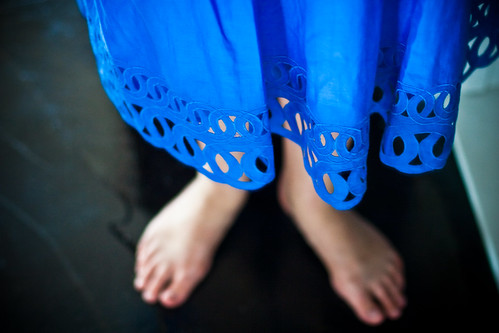
...bought a pretty blue dress to wear to two weddings this summer. Almost left the store without buying it, but changed my mind when I discovered it was 40% off
...learned that I am allergic to the preservative in contact solution. Trying out a new solution that turns to saline after six hours.
...bought lingerie for other women.
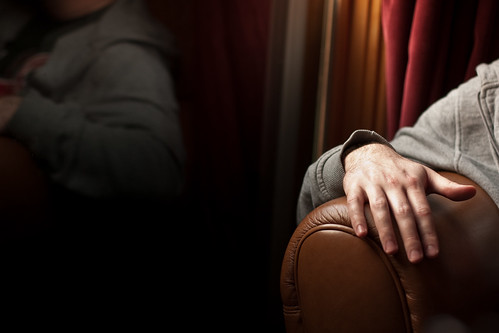
...will be going to symphony tonight
...realized that Filipinas seem to always pronounce my name correctly.
...have been enjoying my day off

This is a duplicate post from my photostream. I've only been posting about really heady stuff recently (wait till the next post, it's a brain twister) and I decided that it's about time for a little frivolity.
A.M. Radio thinks I have a lot of shoes. I don't - at least not in comparison to some (I'm thinking of a certain past coworker who was addicted to buying shoes online). I certainly don't have expensive shoes. It's very difficult to find cute shoes for my ski-like feet. Depending on the manufacturer I can just sqeeze into a size 10, but often fitting into that size 10 would mean that I can't walk more than a few blocks without causing undue harm to my ankles and rubbing them raw. I've spent enough time whimpering about blisters to know now to leave those shoes that 'just' fit on the shelf. I also find it really difficult to find shoes that I like that I can afford. Unlike A. who has two pairs of shoes (one black and one brown) and therefore is able to buy more expensive pairs - I would like a selection of shoes of varying styles and colours, but I don't have the budget to support that dream. So, pair that with my struggle to find shoes that I like and that are in my size, I also have the additional budgetary constraint. These basic flats I bought at Payless. They're cute (check out that pintuck detail!) but won't last for very long because they're as cheaply made as they were to buy. Why can't we get shoes custom made anymore?
So what's a girl to do? Live with only a few basic pairs of shoes? I have two pairs of flats that I bought last year that I've basically worn to death. I don't like replacing shoes every year. I don't care if they only cost $40. It seems wasteful to me. I need a footwear overhaul. Any suggestions of where I can find stylish and comfortable shoes for big feet that are made of quality materials and go with an assortment of pants, skirts and dresses? When I say comfortable I mean shoes that will allow me to walk fast and not require that I slow down (for example I have one pair of heels that I risk death in every time I wear them because I'm always trying to walk as fast as I normally do). I want shoes that make my feet appear delicate rather than clunky (part of the reason why I hate sneakers/running shoes). I prefer classy over sporty... and shoes that can work in both formal and casual situations. I think this will be a lifelong challenge for me. Anyone want to be my personal shoe shopper?
These days you can't seem to avoid conversations about twitter. These conversations leave me with flashes of quincy, as I had the same experience with facebook and to a lesser extent flickr and gmail (although most people I knew seemed less interested in talking about the goog's improvements to email storage and functionality - and even less people in my immediate vicinity wanted to wax fantastical about the wonders of posting photos online). There's no escaping talking about new media. But I won't pretend that I'm not a willing participant. If I was a big fan of bread and butter I might say that this kind of conversation is just like that (that being bread and butter) to me. So, how could I resist an article that presented introductory explorations of the theoretical depths of twitter? It was almost too GOOD to be true (to think I promised no more puns).
I went to a party on the weekend that was full of avid twitters. Inevitably, after guests had lost interest in talking about renovations, conversation moved in the general direction of twitter. There were the usual jokes about twits and twats... and then of course a lot of eyelash fluttering and glassy eyed faraway looks as people schemed about ways to use twitter to further their own agendas (this of course made me roll my eyes, but reluctantly because I can't ignore the influence of the twitter mob - although that influence is frightening). However something did pique my interest... at one point there was an interesting comment about the difficulty of using twitter as a conversation tool. A woman had been trying to contact her rep to complain about some sort of signage problem. But because of the arbitrary character limit on tweets and the limited context one can provide in a post of that length, it had taken nearly eight back and forth messages to communicate the problem. Whether or not the problem was 'solved' is another issue. I wonder, why would this woman use twitter to communicate this problem when an email would have been much more effective? Clearly, the attempt to have a conversation about this issue using just twitter was frustrating and not effective. While contemplating these questions an imaginary light bulb lit up over my head and I wanted so very badly to discuss the idea below (from the GOOD post I linked to above).
Twitter does not encourage conversation or dialogue between Twitterers. It is too real-time and asynchronous for that. Instead, it encourages individual Twitterers to have conversations inside their heads about the various tweets and links they read. One culls from this cacophony an interior dialogue (or, perhaps, a multiply-voiced monologue) that generates new ideas, which one can then add to the mix by tweeting again. Thus knowledge accrues, but not through a back-and-forth exchange.

I had a rather full weekend and haven't had time to type up my review/reflection of the symphony performance from last Thursday. I will be posting it on COLLECTed because I have assembled my thoughts in a more formalized narrative format and less stream of consciousness as I am apt to do here. But I do have some thoughts that I would rather share here than try to work into my story. I attended the symphony as part of a group who received tickets in exchange for participating in an ongoing new media experiment to promote the ESO. Our little group included bloggers and tweeters and we sat clustered together near the back of the second balcony, where hopefully the glow of the various mobile devices of the tweeters would be less obtrusive and less offensive to other symphony patrons. There has been some mild controversy over the live-tweeting experiment and following numerous conversations with Phil (the ESO's New Media Specialist) and other assorted friends and coworkers, I would like to provide my own simplified musings on the topic. There are always people who have felt inclined to record and document. Our history is a progression of these changing methods of documentation and communication - moving from an oral culture to a written culture, radio, television, the internet, etc, etc. But before the advent of digital devices that has loosened our grasp of pen and paper, how did people record their thoughts in a world without twitter? I have this dreamy notion of people wandering around with a journal or notepad tucked away in their breast pockets (not really all that far fetched since I still carry a little book with me), pulling it out to scribble down something of interest. I wonder how many people have replaced that notepad with a smart phone? Sometimes I like to think of twitter as that notebook, except in this online version our notebook starts writing back to us. Between our scribblings words magically appear, posing questions, rallying alongside with us or letting us know of something interesting that we might have missed. Except of course it is not so simple of a comparison. Recording something in a notebook momentarily removes us from an experience. We are pausing to jot something down (and I'll focus just on writing here - photography is another matter) and for the time it takes us to write it down, that becomes our experience. But after our momentary disappearance we return. With twitter or other online applications (like crackbook) our disappearances can extend to longer and longer periods. Life is full of these disappearances, our engagement varies based on levels of awareness. Depending on the situation the 'acceptable' level of awareness changes. And so the debate begins, what is an acceptable level of awareness while attending the symphony? Our behaviour has long been shaped/directed by our situation. Certain behaviours are deemed more acceptable depending on the context. At a rock concert an audience is expected to be more raucous and participatory. Dancing is encouraged (depending on the venue) - the atmosphere is generally more chaotic and wild compared to the sedate formality of a symphony performance. Where spontaneous applause and rowdy cheering may be acceptable and desired at a rock concert, someone yelling "I love you Bill Eddins!" might not have the same effect at the symphony. Instead you would probably be quietly escorted out of the hall by an usher vested in black.
But what about whispered conversations? What about some minor texting? What is the difference? I would think that it has to do with the perception of presence and awareness. No one cares if you are paying attention as long as you look like you are - and you know well enough to applaud at the appropriate times. If you are whispering to someone beside you, one would hope that you are doing so discreetly and during a moment when you are not interrupting others around you (during a break between selections). Sharing those same thoughts to those outside of the room - through a mobile device - is deemed rude, probably because you seem to be focusing your attention elsewhere.
But how aware can we be when two planes are competing for attention? What takes precedence? I would argue that in the case of the symphony performance it is the artists and the music that should take center stage (pun unavoidable here) and the conversation that is supplemental. The performers deserve our attention and we should give it. However, this does not discount the importance of the conversation after the fact - once the performance is complete. In the case of the ESO new media strategy, we need to ask what is it that the ESO wants to promote? They need funds to keep operating, be that through donations, subscriptions or ticket sales. They need patrons to fill the seats. But why? At the risk of being overly simplistic I provide an easy reason, the symphony is fantastic. the artistry, the history, the entire experience. I think those are the things that you want to share with others. Those are the type of things that need to shared in conversation. That story, those details, the experience. The question to ask about live blogging and tweeting is , does the information shared through those tools provide the kind of richness of detail that will attract new patrons? Does the information provide an accurate representation of the experience (be it positive or not)?
This leads me to an exploration of buzz and timeliness. Are concurrent conversations important or is building a long term following a more effective strategy? Once again I find myself debating instant gratification versus a slower approach to building context for conversations online. I use the word 'slow' only because to me it suggests a certain calmness, providing a chance for reflection. It is not a rejection of exciting new tools. It's more so a conscientious approach to think about how, what and why we are talking about things and a realization that our tidbits of conversation all become part of a larger story that people can follow and participate with both online and in person.
I have more to say of course, but this is the type of conversation that needs to exist on many planes.
I was reading the work of a particular freelance writer last week and when I couldn't find a copy of one of her articles online I ended up ordering a journalism textbook where it had been published (my other option was to track down an old copy of Elle magazine). It was a random purchase but since I picked it up from the post office yesterday I've found myself rather engrossed in the textbook.
During the past few weeks, while pitching my grand ideas about using new medias to support the efforts of municipal governments I've frequently been bringing up the idea of storytelling. I think people thrive on stories. Nothing quite compares to a well crafted story that weaves together all the details of an event. Some people are particularly adept at gathering and remembering these details, an ability that is described in the textbook as the fine art of hanging out, a phrase attributed to a writer named Guy Talese. I wonder how well I practice the fine art of hanging out.
This morning on my way to work I passed by a former coworker of mine, a Bulgarian bridge engineer who has lived the most amazing life. In the last few months that we worked together he would often stop and sit with me and another coworker and delight us with stories of his childhood as a violin prodigy and early career as an engineer behind the Iron Curtain. His stories were fascinating and I seem to recall so much of what he told me, even though it's been many months since we last spoke. A few weeks ago I shared his story during dinner with some friends. While telling the story I paused to take a drink and was greeted with silence. At first I thought that I was boring everyone, but I quickly realized that I had the table's full attention. I'm sure this was more testament to the amazing life this man has lived, but part of it must be that I was able to retain those details of his story that made it interesting in the first place.
I am going to continue practicing this fine art of hanging out. If I keep at it, maybe I can end up writing something that is even remotely reminiscent of this essay by Guy Talese.
I figured this warranted a blog post, since I've been all bloggy lately. Or as I prefer to say, I've gone all bloggo.
I'm one of those lucky (or unlucky depending how you look at it) few who are relatively easy to find with a google search. Thanks to ol' web 2.0, I show up in the top three when you just type in my first name, and if you type in my first and last name I take up almost the entire front page. I've been pretty aware of this for some time (I like to google myself and other people I know) and I know that whatever I put on the internet other people can see. But that information just happens to be a lot easier to find than some people.
I read about the goog's recent efforts to bring back some of that control over what people know about you through search by the creation of google profiles. Perhaps this is another effort for the goog to take over the world, but it's also one of those well, of course sort of features that we expect from the googletron.
I've mused about online identity in the past, but I've never really gone into any sort of depth exploring what that actually means to me. I probably won't explore this too deeply now, as I tend to keep things fairly succinct on this site (I too must be getting lazy in this age of 140 characters). Much of what I post online is seemingly personal, I am not afraid to share how I feel, a trait which is not dissimilar to what I am like in person. I am a highly emotive individual. But of course that is only a part of me. I choose what I share online and I am not ashamed of it. However, do these outlets present the best professional side of me? Do I need to take more care in highlighting my other abilities that relate to what I do for a living? It's not as if I haven't also shared that information, but it's swirled together with all of my other online explorations. What I've presented is a mix of all that I have to offer - a little bit of theoretical analysis here, some photography there, a touch of design, a smidge of caustic wit - but it's never been a focused effort to assemble those bits and pieces that I've posted here and there to provide the world with a more fully formed online version of moi. For now I've left it up to the curious individual to glean what he or she can from what I reveal about myself and to make connections and linkages for her or his own self. There's only so much control one can exert over the information on the internet - and that control really amounts to what we post online. Everything is open to interpretation. Do I really want to meddle more with that?
I read something the other day (and I can't seem to locate the original source otherwise I would link to it), but basically it said that today there is an expectation of open communication and transparency - we expect information and we expect it immediately. However, as we are more conscious of this desire for disclosure, we exert even more control over that information, in that we attempt to control the message, tailoring, structuring, spinning, strategizing and coordinating. We want to control the outcome. We want to control people's interpretations. But we can't. So I'm debating what I want to do next. I like the idea of allowing people to come to their own conclusions about me. Whether or not that involves me tending to another online space has yet to be determined.
I'm one of those lucky (or unlucky depending how you look at it) few who are relatively easy to find with a google search. Thanks to ol' web 2.0, I show up in the top three when you just type in my first name, and if you type in my first and last name I take up almost the entire front page. I've been pretty aware of this for some time (I like to google myself and other people I know) and I know that whatever I put on the internet other people can see. But that information just happens to be a lot easier to find than some people.
I read about the goog's recent efforts to bring back some of that control over what people know about you through search by the creation of google profiles. Perhaps this is another effort for the goog to take over the world, but it's also one of those well, of course sort of features that we expect from the googletron.
I've mused about online identity in the past, but I've never really gone into any sort of depth exploring what that actually means to me. I probably won't explore this too deeply now, as I tend to keep things fairly succinct on this site (I too must be getting lazy in this age of 140 characters). Much of what I post online is seemingly personal, I am not afraid to share how I feel, a trait which is not dissimilar to what I am like in person. I am a highly emotive individual. But of course that is only a part of me. I choose what I share online and I am not ashamed of it. However, do these outlets present the best professional side of me? Do I need to take more care in highlighting my other abilities that relate to what I do for a living? It's not as if I haven't also shared that information, but it's swirled together with all of my other online explorations. What I've presented is a mix of all that I have to offer - a little bit of theoretical analysis here, some photography there, a touch of design, a smidge of caustic wit - but it's never been a focused effort to assemble those bits and pieces that I've posted here and there to provide the world with a more fully formed online version of moi. For now I've left it up to the curious individual to glean what he or she can from what I reveal about myself and to make connections and linkages for her or his own self. There's only so much control one can exert over the information on the internet - and that control really amounts to what we post online. Everything is open to interpretation. Do I really want to meddle more with that?
I read something the other day (and I can't seem to locate the original source otherwise I would link to it), but basically it said that today there is an expectation of open communication and transparency - we expect information and we expect it immediately. However, as we are more conscious of this desire for disclosure, we exert even more control over that information, in that we attempt to control the message, tailoring, structuring, spinning, strategizing and coordinating. We want to control the outcome. We want to control people's interpretations. But we can't. So I'm debating what I want to do next. I like the idea of allowing people to come to their own conclusions about me. Whether or not that involves me tending to another online space has yet to be determined.

I've recently been thinking about how various levels of government use various new media/social media tools to engage with their constituents. I've been reading all sorts of studies, reports, conversations about this topic, trying to make sense of portions of it so I can apply it in my job. Although this is above and beyond what I was hired to do, it is not an unnatural extension of my job. This is something I'm doing willingly and on mostly my own time. Have I finally found a niche?
Of the things I've been reading/observing...
Bernie Hogan's "Networking in Everyday Life" via danah boyd
Twitter is Not a Strategy via e-politics
Change Camp Strategy Session Vimeo Summary via (roundabout) Change Camp
Pre-Expert Policy Forum - Draft Research Report Who is Getting the Message? Communications at the Centre of Government via Oliphant Commission
Those are just a sampling of the ideas I've been processing and attempting to draw connections between. I'm trying not to get caught up in the hype of certain tools and instead focus on the issue of apathy. How do we make people interested enough to participate meaningfully? This should be fun.

I think it's widely accepted that weekends are not long enough. However, when a 'long' weekend comes along usually I don't feel like they were long enough either. This past set of days off has been a little different. I feel like I've got it all done, socializing, photography, relaxing, dinner with friends and family, and now a day off at the end to think and knit.
As I've been getting older it's been harder and harder for me to sleep in. I've always been a fitful sleeper and my body doesn't differentiate between work days and weekends. So, for the past few days I've been up at my regular work time, my mind and body active. A., however, has an amazing ability to sleep... so I've spent a few hours in the morning before he wakes up doing a few quiet activities here and there, writing, reading, RSSing, and roaming on the internets. These are not unusual activities, but for some reason they had a certain air of freshness about them. Perhaps it was the weather outside. We have been experiencing a series of glorious spring days, it's been sunny and the sky has been a picturesque blue with big fluffy clouds. I suppose it felt more summer than spring. The city seemed almost foreign and I felt like I was on vacation in a different city, where the light has a certain crispness and all you can hear is the traffic below.
The rest of the day belongs to me. I have nothing I must accomplish which means I can do whatever I want. I love days like this.
So I have this other little blog project that's been 'under development' for many months now. I just haven't given it the attention that it deserves. I know what I want to do with it though but I just have to work a little bit harder to generate content and find some other contributors to the project. In addition to this non-profit venture I also am working on yet another web related project at work. I've pitched my concept to a few key people so far and much to my surprise it's being received favourably and moving along at a pace that I never would have anticipated. Now is a time for action.
I've been working on a 'social media' project at work recently and I've been thinking a lot about the proliferation of these tools and the changing nature of communication. Locked in my solitary think tank I have begun to focus on the obsession providing people bite-sized chunks of information, supposedly making information more manageable (As if we need to sample even smaller morsels before deciding whether or not to digest an entire article or story or anything). Why are we doing to information what we did to food? Do we really need to make information that much faster?
Is this not always the argument? Fast food versus slow food? Quanity versus Quality? Efficiency versus Effectiveness?
I am tired of superficiality.
Is this not always the argument? Fast food versus slow food? Quanity versus Quality? Efficiency versus Effectiveness?
I am tired of superficiality.