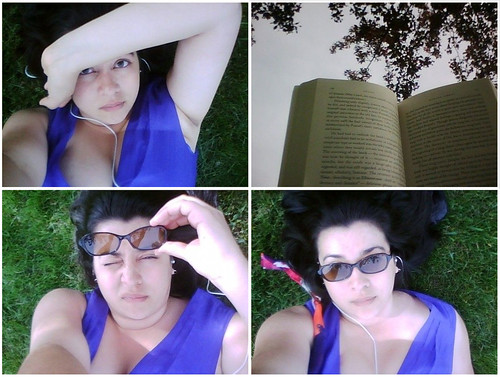
I have to work an event on Sunday so rather than bank the time I took the time off in lieu Friday afternoon. I headed to the university for a lunch meeting to talk generally about technology integration in academia and government and then strolled down to Corbett Hall to read in the shade out on the lawn. Everything about the afternoon was fantastic, from the temperature, to the breeze, to the proximity to potential hydration and washroom facilities.
As I alternated between lying and sitting with my book while listening to the least distracting music I could find on my iPod (so I could drown out the sound of the traffic nearby), I tried to recall the last time that I had done something like this by myself. And I couldn't remember. It was a bit shocking to me, because I have always liked to think of myself as an independent person who would just go off and do my own thing as it pleased me. But I've realized, since moving to Edmonton I haven't done a lot of that. Every so often I would go off on a little photo exploration by myself, but those were infrequent . I moved to this city and instantly became a part of another person's social network and didn't veer far off from there. Maybe I'm just slow to start socializing on my own? Maybe it took me this long to settle in and feel comfortable enough in the city to start doing my own thing again. All I know is that I've been enjoying my time alone. I've been enjoying my recent surge of initiative to get out of the house, start new projects at work, try to forge new relationships with people (be it work or personal). Sure, this return to independence has been sort of dumped on my lap recently, but I'm taking on the attitude of one of my close friends, an attitude that I've taken to calling the Jackson approach. Basically, life is wonderful if you make it so. All the frustrations, hardships, challenges, battles, emotional turmoil... these things pass, and they pass quicker if you choose to move on and return to doing things that you enjoy doing, especially when you do them with gusto.
So what do I enjoy doing with gusto? I enjoy spending afternoons in a park with a good book and ample opportunities for people watching, I enjoy connecting with people through my intellect , I enjoy writing long streams of consciousness where I record my observations, I like trying to be funny and charming, I like being a little bit unpredictable and forcing myself to trying new things that previously made me uncomfortable (namely potentially embarrassing myself with athletic pursuits that require any sort of real coordination), I enjoy taking pictures and encouraging others to take pictures, I enjoy immersing myself in theory and then finding ways to link it to every day life, I like going for walks after work and filling my head with little narratives that may or may not come true. This list could continue on. There are endless more things I enjoy doing and will continue to enjoy doing. No need to be sorry Mr. Jackson, I am for real.
documentary © Raffaella Loro
On Friday, after a delightful lunch with my chum-of-all-chums, I rushed to the downtown university campus for a lecture on mediated gossip that was being given as part of the University of Alberta's Communications and Technology Research Symposium. The visiting scholar, Professor Leopoldina Fortunati, from the University of Udine, was to speak about reflections on mediated gossip, particularly, how the use of ICTs (information and communication technologies) has modified one particular register of communication: gossip.
The lecture wasn't exactly what I thought it would be. Although interesting, did not really provide me with the level of depth about how information and communication technologies actually mediate gossip. That's the problem with relatively short lectures... there is much time spent covering the background information about a particular study or subject - and not enough time and depth exploring the real topic. But that disconnect may also be a result of an incorrect description of the scholar's presentation, we're promised more than is actually intended to be delivered due to time constraints or the efforts of the event organizers to make a talk 'fit' both thematically and within an allotted time slot. I've been to a few lectures in the past where the presentation given did not necessarily correlate with the description that had been released to the public. However, despite this minor discrepancy the lecture did still provide me with some points for discussion.
A few months back I wrote a short post about how I sometimes feel that the real me is a hybrid of my physical self and my online self. I was immediately reminded of this post when Dr. Fortunati spoke about the social presentation of self as a combination of the front-stage self and the back-stage self. Basically, we present different parts of our personality depending on our social sphere. We maintain a series of different social spheres with varying levels of proximity. So, if a person is part of a social circle that is closer to us we reveal more about ourselves and so on. Basically we have different types of relationships with people from our various social circles. Our family knows certain things about us, our friends know something different, our coworkers something different once again. There may be some overlapping information (imagine a Venn diagram representing the different social circles we interact with), but generally we try to keep these circles separate and distinct. Our relationships with other people within these groups is based on what we know and what we don't know about each other. This weave of information gives a relationship its tone, amplitude, and depth. However, it becomes increasingly difficult to maintain a distinction between these social circles in a world where information, both personal and professional, becomes increasingly available on the internet. This blurring of the lines creates a discontinuity of self and makes it difficult for others to decode what what we communicate. Take for instance the overused example of an employer coming across something online about a potential employee and that information changing their perception of that individual. Then of course there is the example of meeting someone new, befriending them on facebook, and through their profile and other assorted links discovering all sorts of information about that individual that you would have never have known before (or at least not known that quickly). So what does this have to do with gossip you might ask... well plenty, if you think of all this information that we share online about ourselves to be gossip - and not necessarily gossip of the malicious kind. Gossip, according to Fortunati, is a communicative game with a strong dimension of amusement and entertainment (but the game can be cruel). Gossip may not advance true knowledge, but it does enhance common thinking and social cohesion. As information and communication technology has developed, particularly in the explosion of social media in the past few years, we have begun to shift our socializing to the digital sphere. We continue to gossip about ourselves, but now we face the challenge of how to deal with increased access to gossip as well as the impact of longevity.
There were a few other key points that I found to be of interest, in particular Fortunati's comment how in a world where neighbours and acquaintances are part of an anonymous crowd, people are turning to their neighbour substitutes. These substitutes could be celebrities, random strangers online, or the profiles of individuals we once knew or people that we've had fleeting contact with in the physical world but have befriended online. This comment is worthy of a post all on its own, but I'm tired and don't think I have it in me to write anymore today. Maybe another day... I don't even know if anyone reads this gossip rag. Say hello in the comments if you do. You can remain anonymous - maybe you can just indicate if we actually know each other in the real world. That would be an interesting experiment...
Update: Just discovered that there is a PDF version of Fortunati's paper that was the basis for her presentation. I'll have to read it.
What value do we place on information? If information is free are we more willing to filter through junk? Is there an expectation if we are paying for something it will be of a higher quality? I think about this as I ponder about the idea that somehow this new breed of citizen journalists will change the world. Citizens have no obligation to hold themselves to a code of ethics - they can do as they please - they do not need to fact check (but sometimes it seems that journalists feel they don't have to either). This isn't to say that there aren't people out there who hold themselves to a higher standard - there are remarkable people out there who influence and inform without any formal training. But that's just it. They're remarkable people. They will excel no matter what the medium.
My major concern about a major shift to citizen journalism as the main source of information lies in the fragmentation of information - with information becoming so specialized, with the obsession that everything is news and that anyone can be a journalist. Not everyone has the ability to create things of quality. A hammer and chisel do not a skilled carver make. It not just about access to the tools, it's also about ability and talent.
This all seems slightly hypocritical of me. Here I am publishing content to the web with no filters and no (direct) cost. I have access to a seemingly infinite audience, yet there are limits to this audience. Sure, I can write about whatever I please, but at the same time what I please to write about is only so interesting or valuable. I could market or promote my writing more competitively, but for what gain? I may have access to my own publishing channel but I don't have the time or the resources readily available to make it worth the effort. I'm not getting paid to write this - and I don't really have the desire to try to compete with other media outlets. I am supplemental, not a replacement.
Yes, I realize that the real competition for traditional media outlets by citizen journalists comes en masse rather than on an individual basis. But how do we filter through all the noise to find something valuable? How do we wade through all the new channels to increase our knowledge and understanding?

Last year I spent the majority of May in Trinidad. I missed the real transition from winter to spring. I left the city when the leaves were beginning to turn and when I came back it wasn't such a shock to find that spring had arrived. This year, however, I have not had any happy escape from the inconsistencies of spring. I have endured it all, the early tease of warm weather, followed by a few spectacular thunder showers, and much to my dismay, a few days of horrid snow. But I think we might be done with Mother Nature's mood swings for a little bit. This weekend was particularly fine and I took it upon myself to leave the confines of my apartment as often and as long as I could. Mostly I just went for some aimless walks, wandering across the High Level Bridge half listening to really bad pop music on my iPod to drown out the sound of traffic beside me. I wandered through the residential areas of Garneau and poked about a bit on campus, but mostly I was just out for a random stroll. Destinationless walking is always a bit intoxicating. I usually want to go a little bit farther and don't really want to turn around. Eventually I would though and I would be a little bit disappointed passing by spots for a second time.
On Friday I realized that I didn't have any good walking shoes so I popped into a shoe store on Whyte with the hopes of finding some plain black leather flats that could serve as my summer walking shoes. Of course it would seem that anything over size 10 in women's footwear is deemed unfit for sale. It's not as if my feet are really that big. They don't look out of proportion to the rest of my body, they're not gnarled or unsightly, they're normal feet. So, why is it so bloody difficult to find shoes for them? Why is this my curse? I've gone to so many stores and it seems that the only shoes that come in sizes above 10 are these clunky things that you might put on an elephant with orthopedic issues. Needless to say I'm not impressed. I try to support local businesses and they fail to take my needs into consideration. But I digress.
Today I spent a lovely afternoon in the park with my friends Wade, Phil, Christy and Marc. We were a relatively quiet bunch today, snacking on our makeshift picnic and lying prone on an eclectic collection of blankets and beach mats near the water, some of us reading, some sleeping, and others still performing a hybrid of the two. I attempted to assemble my thoughts on the lecture I attended on Friday, but my brain needed a rest. Later I told it, later I'll let you think.
I spent the last bit of the afternoon watching my amigos toss a frisbee back and forth, snapping a few shots of the action (although my 70-200 would have been much better suited than the lenses I was using). I was reluctant to join in myself, mostly because my arm is completely erratic, but I've realized that is no excuse. Perhaps this summer will be the one where I learn how to throw a frisbee properly. I've already decided that this summer I will take golf lessons, so what's another goal to add to the list?
After a long and difficult winter I am ready for a summer of infinite possibilities.
I started writing this around the 19th of May but I'm actually only posting it on May 24th.
There is embedded in every great technology an epistemological, political, or social prejudice. Sometimes that bias is greatly to our advantage. Sometimes it is not. The printing press annihilated the oral tradition, telegraphy annihilated space, television has humiliated the word; the computer, perhaps, will degrade community life.
I realize that not everyone takes to readily to the application of theory in their daily lives, but for me, when I am trying to take in the bigger picture, I find theory a helpful way to provide a contextual framework for how things work. I suppose in some ways I should have been an academic, alas I am not. But theory is not limited to the field of academia. Imagine for a moment if the general public were more open to discussing theory. Consider the possibilities of understanding... That, however, is my utopic vision of the world. Instead we go about our everyday lives with an intense fury and don't always leave enough time to think at a deeper level. What concerns me most is not the so much the speed and intensity at which we live (which does still bother me) but the level at which we think. We're not afraid to inundate ourselves with endless reams of superficial data, but when it comes to that theoretical context - we just gloss over it - and provide information in "digestible chunks" as if we're too stupid to work through information presented in great volumes.
I write a lot about my conflict with information technologies - I find the computer a useful tool and I find it exciting that it makes a wealth of information available to us, but what purpose does that wealth of information serve? I think about this after reading up about digital engagement in the UK this morning... lots of things floating about in my head.
Postman said that all technological change is a trade-off, what he called a Faustian bargain. Postman felt that culture always paid the price for technology. Technology giveth and technology taketh away, meaning that for every advantage a new technology offers, there is always a corresponding disadvantage. The disadvantage may exceed in importance the advantage, or the advantage may well be worth the cost. He further expressed this idea to say that the question, "What will a new technology do?" is no more important than the question, "What will a new technology undo?" He posited the latter question is more important, precisely because it is asked so infrequently.
So as I work on this project - a project with the lofty goal of using of online tools as part of a solution to break down barriers between governmental departments and help communicate to the community what is happening at a programs level - I have to wonder, what will this new technology undo? How can we achieve a balance between participation online and participation in the physical realm? How can we use these tools to help change attitudes? To what level do we serve to inform? To what degree do we seek to influence?
I think we will eventually arrive at some kind of micro payment/advertising business model for online media in the not too distant future. Ideally there will be a common payment system on the device I use to access media or some kind of accepted everywhere pass. Either way it only works if the transactions are in the background.
The subscription model for Newspapers and Magazines that I’d like to see would allow me access to all the headlines and blurbs for each story but limit the number of full stories I can see/read each month/week depending on how much I’ve paid.
The cost for these subscription models is critical. I would read 1 story a month from 10 or 20 magazines and several stories a day from a couple different newspapers but not if it costs hundreds of dollars (based on current subscription prices). I think there could easily be ways to lower the subscription cost if I agree to watch and interact with special advertising or allow cookies to be set on my browser so the advertisers can follow me around and gather data. I can also envision a 2 year multiple magazine/newspaper subscription model where just like cell phone companies the media reader is free or significantly discounted.
One concept that publishers will struggle with is how efficient blogs and social networking are at distributing stories and bringing in new readers, because once you put a pay wall up that will end. The key to this is realizing that hits are worthless and loyal readers are valuable. I think there’s a way to allow your paid subscribers the ability to distribute full stories to their friends/audience along with embedded advertising and a pitch to subscribe. This kind of sideways distribution is critical for niche publications and they will need to find the balance point between content that is freely distributable and content you have to pay to see.
Of course none of this addresses the the most critical issue Magazines and Newspapers are facing right now. Most of the content is not worth paying for (bolding my emphasis). Fixing that will require either a heavy investment from publishers or a changing of the guard.
I agree with the key issue presented here - most of the content in magazines and newspapers is not worth paying for. Which is a real shame because if the people who are getting paid to write can't produce good content then we are in a sorry state indeed. But that poses another question - why is content so poor? Surely good content still exists (I know it does), but perhaps our ridiculous need for instant gratification has put the emphasis on trivial information rather than an informed story. Who can we blame for this shift... the audience, the writers, the publishing icons? Is it the technology that is to blame, having made content "free"? Is this technological determinism at play?
I like to think that we're smarter than the technology. Technology is a tool and society can determine how to use that tool - not the other way around (reminder to self - must read more about social construction of technology, seems interesting). However, eventually the use becomes habitual and the distinction between the tool and how we use it becomes blurry. It is our habits that shape society, but when we can no longer distinguish between what we do and the tools we use to do, it is easy to start blaming the technology for changes in society. So when we consider the slow death of newspapers and magazines, it is important that we look at not only the tools for distribution (print vs. online) but also examine audience interaction as well as the expectations of content and quality.
Whenever some new tool for distributing information comes on the scene there are always people who start making proclamations about the death of the last tool. Par example,
Printing Press versus Town Crier - Death Match on Sunday, Sunday, Sunday...
Video kills Radio Star - All the grisly details at 6 (update at 7, YouTube killed the Video Star, Copycat Killer?)
Citizen Bloggers take on Conglomerate Journalists - In this Battle Royale Who will Survive?
Perhaps my examples are a bit hyperbolic, but you get the idea. Competition between communication tools is tough especially when tools from different weight classes are in the ring together.
Over the weekend A. and I saw State of Play at the cinema. It was your typical sort of politico-thriller, full of plot twists involving two investigatory journalists - one from the old guard (the gladiator of print) and new guard (the online notebook blogger) - their regal editor (the Queen herself) and scandal involving a young state senator and to a lesser extent his (princess bride) wife. Having written the majority of this post about a week or so prior to seeing the movie (insert a week or so above this paragraph), it was interesting to watch the movie with these thoughts about the changing nature of information distribution at the back of my mind. I felt this film was in a way a gritty ballad about the newspaper industry. The story focused on how the two journalists - the well seasoned writer (he was suitably peppery with just a touch of grease) and the saucy young ingenue (appropriately costumed in jersey cotton with a slouchy handknit toque) - worked to piece together the real story behind the scandal. There were numerous references to the battle between traditional print and online columnists - the challenges of timeliness of content vs. quality (read - validity) of content. The film on its own was entertaining and it was probably only because I had been musing about newspapers that I left the theatre thinking about how we need to spend more time considering the impact of our decisions to access information using different tools. This does not just apply to the difference where the content is coming from, but also the larger societal implications of our decisions. The film ended with the story of the scandal being sent to print. As the credits were rolling the camera led the audience through the mechanized printing process - and we followed the physical newspaper being developed, moving from giant rolls of paper through massive rollers - being folded and packaged into bundles and then loaded on to delivery trucks waiting outside. Imagine what happens to all those people who are employed once a newspaper goes to print. If we destroy that mode of delivery altogether what happens to them? What happens to the individuals who repair the machinery, work in the warehouse, drive the delivery trucks, manage the newspaper stands, hand deliver the newspapers? Shifting distribution of information online has a greater impact than we tend to realize. There needs to be more recognition of that.
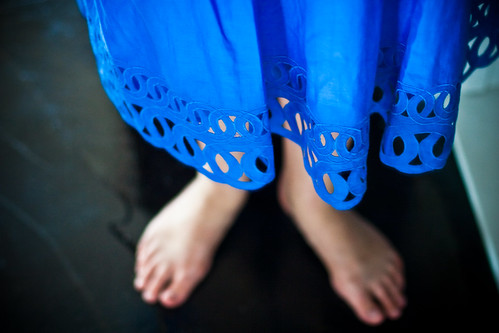
...bought a pretty blue dress to wear to two weddings this summer. Almost left the store without buying it, but changed my mind when I discovered it was 40% off
...learned that I am allergic to the preservative in contact solution. Trying out a new solution that turns to saline after six hours.
...bought lingerie for other women.
...will be going to symphony tonight
...realized that Filipinas seem to always pronounce my name correctly.
...have been enjoying my day off
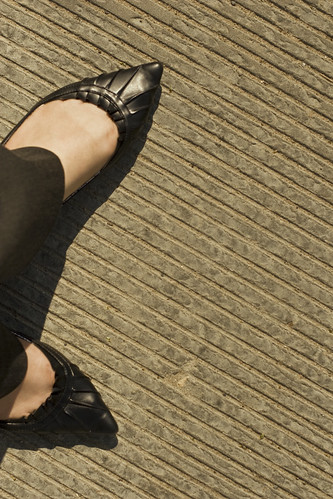
This is a duplicate post from my photostream. I've only been posting about really heady stuff recently (wait till the next post, it's a brain twister) and I decided that it's about time for a little frivolity.
A.M. Radio thinks I have a lot of shoes. I don't - at least not in comparison to some (I'm thinking of a certain past coworker who was addicted to buying shoes online). I certainly don't have expensive shoes. It's very difficult to find cute shoes for my ski-like feet. Depending on the manufacturer I can just sqeeze into a size 10, but often fitting into that size 10 would mean that I can't walk more than a few blocks without causing undue harm to my ankles and rubbing them raw. I've spent enough time whimpering about blisters to know now to leave those shoes that 'just' fit on the shelf. I also find it really difficult to find shoes that I like that I can afford. Unlike A. who has two pairs of shoes (one black and one brown) and therefore is able to buy more expensive pairs - I would like a selection of shoes of varying styles and colours, but I don't have the budget to support that dream. So, pair that with my struggle to find shoes that I like and that are in my size, I also have the additional budgetary constraint. These basic flats I bought at Payless. They're cute (check out that pintuck detail!) but won't last for very long because they're as cheaply made as they were to buy. Why can't we get shoes custom made anymore?
So what's a girl to do? Live with only a few basic pairs of shoes? I have two pairs of flats that I bought last year that I've basically worn to death. I don't like replacing shoes every year. I don't care if they only cost $40. It seems wasteful to me. I need a footwear overhaul. Any suggestions of where I can find stylish and comfortable shoes for big feet that are made of quality materials and go with an assortment of pants, skirts and dresses? When I say comfortable I mean shoes that will allow me to walk fast and not require that I slow down (for example I have one pair of heels that I risk death in every time I wear them because I'm always trying to walk as fast as I normally do). I want shoes that make my feet appear delicate rather than clunky (part of the reason why I hate sneakers/running shoes). I prefer classy over sporty... and shoes that can work in both formal and casual situations. I think this will be a lifelong challenge for me. Anyone want to be my personal shoe shopper?